F1
Synchronised speed, strategy and precision: Unpacking the perfect pit stop
There’s plenty that goes into achieving the optimum F1 pit stop, and Oracle Red Bull Racing has achieved it more than most …
In a sport that can move at 350km/h, the thin line separating the top step from the rest of the field in Formula 1 can often come down to being the fastest when you’re slowest … as in completely stopped.
For while pit stops are a necessary element of traversing the 305km distance from start to finish in an F1 Grand Prix, they’re also one of the key battlegrounds in a sport where tiny slivers of time can be critical.
They’re highly synchronised seconds of high-stress theatre, the definition of teamwork where races can be won or lost, and where the quest for perfection pushes the boundaries, remaining tantalisingly within reach without ever being touched.
There’s always time to save, advantages to gain …
What goes into a Formula 1 pit stop? What factors separate the great from the merely very good? How much does strategy and team play come into the equation? What rules do the teams have to follow?
Here’s the lowdown.
Unpacking the perfect pit stop
© Getty
Why make a pit stop at all?
The short answer is that you have to, if only to change tyres.
F1 regulations require each driver to use two different compounds of tyres from three options (soft, medium or hard) during a race unless it has been declared ‘wet’, where drivers can elect to stay on the same set of intermediate or full wet tyres should they choose.
That requirement to pit at least once opens up myriad strategic options for each driver in each team and within the teams themselves, with those options varying between circuits depending on the characteristics of the tracks, some of which will wear out tyres faster than others because of the stresses placed on the rubber during cornering, the abrasiveness of the tarmac, and the temperature of the surface.
Unpacking the perfect pit stop
© Getty
If you’ve ever watched an F1 race, you’ve heard the terms ‘undercut’ and ‘overcut’ when discussing the timing of pit stops.
Broadly, an undercut means a driver will pit earlier than a competitor they may be behind on track to have new tyres fitted and use the performance gain from fresher rubber to leapfrog their opponent after they make their own, later, pit stop.
Of course, the trade-off comes with having older tyres than the competitor you may have passed for the next stint of the race before a subsequent pit stop if required, or the balance of the race if one stop is all that’s required or deemed possible with the degrading of tyres over the next stint.
The overcut is, essentially, the reverse strategy; stay out on track longer as your competitor pits, extract everything you have out of your tyres as they’re wearing down, then pit to try and stay ahead of them when you emerge back on track, maintaining the status quo. The key laps are those between your competitor’s pit stop and your own; even one no-holds-barred lap after your rival stops can make the decisive difference.
When – or when not – to pit comes down to pre-race meetings between the driver and their strategic teams who sit on the pit wall, and the ability of each team to ‘read’ the race by seeing where every car is on track via GPS data, assessing or anticipating what their rival drivers and teams are doing strategically.
Having an eye on the weather radar is a must, too.
Unpacking the perfect pit stop
© Getty
What role does the safety car play?
The likelihood of a race being neutralised by the intervention of the safety car, which can be deployed for an on-track incident like a crash, debris being on circuit or because of inclement weather conditions or reduced visibility, among other reasons, can be a game-changer.
With the field regulated to a slower speed behind the safety car – meaning the time lost by making a pit stop is much less than when the pack is racing under normal green-flag conditions – teams will often shift strategy on the fly to make the most of the chance to take a ‘cheap’ stop, particularly if the safety car comes at or near a time where a driver may be scheduled to stop regardless.
The one curveball? You never know how long a safety car period (or virtual safety car, where drivers are restricted to a lower speed for more minor incidents without the intervention of the safety car proper) will last.
There’s few worse feelings for a driver or team than committing to a pit stop under safety car conditions … and having the Grand Prix resume at normal racing speed if it’s deemed safe to do so as you’re trundling down the pit lane.
Unpacking the perfect pit stop
© Getty
What does each team member do in a pit stop?
Once the call from the pit wall to a driver to pit is made across the radio – teams will use the word ‘box’, derived from the German word boxenstop and used for sake of clarity and brevity – the mechanics will assemble with the compound of tyres dictated by the pit wall for the incoming driver, which have been sitting in electrically-heated tyre blankets in order to be at the right temperature for peak performance.
How did the Team get on in the dark?

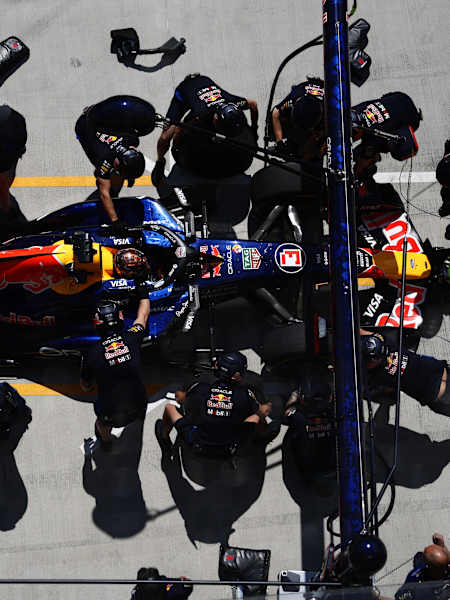
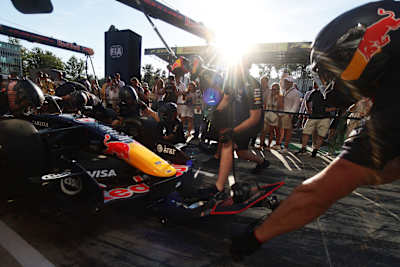
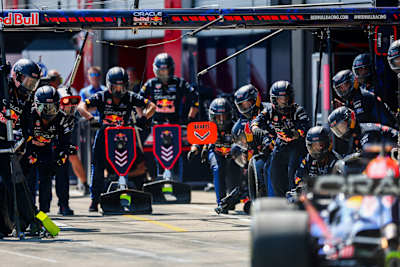
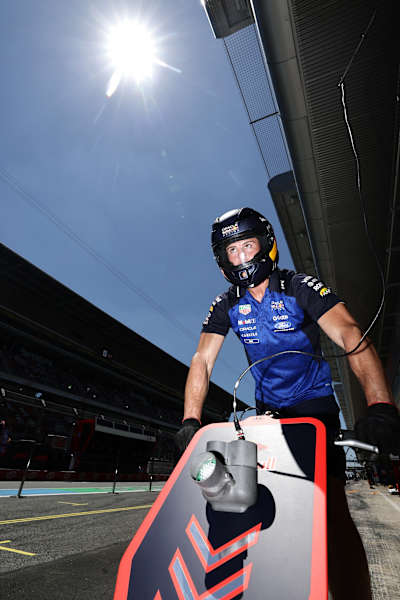
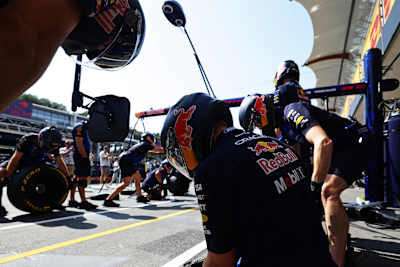
A human garage of 20-22 pit crew members meets the car when it comes to a stop at a position dictated by a mechanic holding a marker board, where it is first lifted at the front and then the rear by two separate ‘jack men’ to raise the car to enable the wheels – which weigh 20kg at the front, 23kg at the rear – to be changed.
Each of the four wheels has three crew members – one who deploys the wheel gun to loosen/tighten the wheels, one to remove the existing wheel and tyre, and one who fits the new one. One the wheel gun operator has affixed the wheel correctly, they press a button on their wheel gun to indicate to the jack men that it’s time to lower the car back down.
At the front of the car, a crew member referred to as the ‘traffic light man’ releases the car on the instruction of a car controller, who monitors the pit lane to see if it’s safe to send the car back out into the ‘fast lane’, where cars are restricted to 60-80km/h (depending on the circuit, and for safety reasons) as they enter and exit the lane.
Directing the car into the path of a rival’s car as it traverses the pit lane can be deemed as an ‘unsafe release’ by race control, which can be penalised by a time penalty (typically five seconds added to a drivers’ race time, or at the next pit stop before a team can service their car) or, in particularly egregious instances, a drive-through penalty, where the driver must enter the pit lane and stick to the speed limit and exit without their car being serviced, a race-crippling punishment.
With such precision required and with the ramifications of a pit stop – good or bad – being so significant, teams will practice their pit stops leading into a race weekend by simply rolling the non-running car into place and perfecting their craft.
In the off-season, teams will train and develop team members for specific tasks within a pit stop, with the length of a modern-day F1 calendar (24 rounds across nine months) meaning that not every team member does the same job on the same car at every Grand Prix.

10 min
What It Takes: Pit Stop Practice
How are the best pit stops rewarded?
There’s a competitive element that goes into pit stops that stretches beyond the race at hand, too.
Since 2015, the DHL Fastest Pit Stop award is an acknowledgment of the work done in the pit lane by the teams, with the same scoring system used in a Formula 1 race from first to 10th place (25 points for the winner down to one point for 10th) used to rank each team’s pit stop from fastest to slowest in a single race, and then tallied over the duration of the season.
Since its inception, Oracle Red Bull Racing has won the award seven times, all in succession from 2018-24, and peaking in 2020 when the team recorded the fastest single pit stop in 15 of the 17 races.
In a period where the team won four drivers’ and two constructors’ championships, that speed and precision while stopped wasn’t the sole determinant of success, but it’s not nothing either.