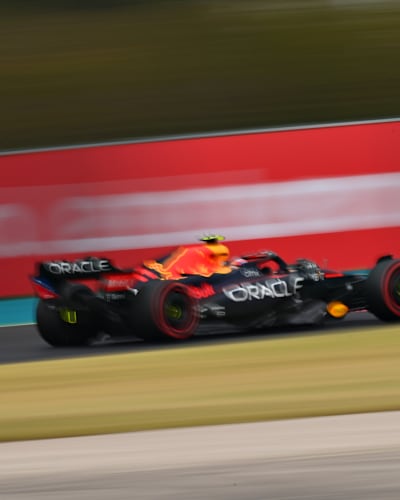


After a third podium of the season for Max and Isack’s brilliant charge from 21st on the grid to P6 last weekend in Belgium, hopes are high for Hungary. But Budapest’s twisty, technical and toasty circuit couldn’t be more different to Spa. So, great expectations or hard times in Hungary? Let’s find out…
01
Memorable moments
02
What makes the Hungaroring unique?
Welcome to F1’s kart track. There really isn’t another circuit like this on the calendar. The 4.3 km track has been poured into a small, natural amphitheatre, and the result is a tightly flowing layout featuring closely linked sequences of corners and a single straight that, for all the world, feels like a go-kart venue.
That doesn’t mean it’s easy, however. The Hungaroring has handed us plaudits and brickbats in equal measure. We’ve had four wins – in 2010, 2014, 2022 and 2023 – but also double DNFs, crashes, calamities and plain old clunkers.
So, is it a beauty or a bogey track? As Max said last year, it’s a bit of both. “The Hungaroring hasn’t always been our strongest track. I like the technical second sector but it is, of course, difficult to overtake, so we will need to make sure we have a good qualifying session, and it is very important there to find the right balance of the car.”
03
Circuit characteristics
At just 4.381 km, the Hungaroring might be one of the shorter circuits on the calendar, but there’s plenty going on across its 14 corners. Indeed, with just one short straight followed by a flurry of complex, linked corner sequences, the Hungarian circuit provides a proper physical and mental workout for F1’s drivers.
The undulating flow of low- and medium-speed corners means finding a good rhythm is crucial to setting a good lap time, and central to achieving that flow state is a well-balanced car. Dial in the right set-up and, for a driver, the Hungaroring can swing like great jazz. Get it wrong and it’s like an hour and a half of clanging, atonal industrial metal.
Sector 1 is basically the 908 m pit straight, the tight right-hander at Turn 1 and the left-hander at Turn 3. Sector 2 is where that balance and confidence are really crucial, as the track heads uphill through the fast Turn 4 and the sweep of Turn 5 before giving way to quick changes of direction from Turn 6 to Turn 11. The final sector features the hairpin at Turn 12, the long arc of Turn 13 and the long, final right-hander at Turn 14.
04
Key overtaking zones
Overtaking has traditionally been tricky here, making qualifying and track position especially important. It can be done, however. The tight Turn 1 right-hander provides a good opportunity and, if you can’t quite get the job done there, staying close will give you another shot through the long radius Turn 2.
Unusually, Turn 4 has also become a place where the boldest drivers have a go, as Max proved last year when he made a risky move past Lewis Hamilton stick there.
Of course, F1 is bringing all-new cars to the Hungaroring this year, and its twisty layout suggests there should be few concerns about energy starvation. That made Austria a thriller, and the same is likely in Hungary. There could be closer battles, more strategic tussling and more overtaking. Or not. As Max said last week in Belgium: “Welcome to F1 2026. Sometimes it can be a jungle.”
05
Strategy watch
The best strategy at the Hungaroring is to get yourself as high up the grid as possible. As we’ve said, overtaking has historically been tricky in Budapest, and securing a good starting position does a good chunk of the work for you.
That isn’t easy, however. Track evolution here is massive. The Hungaroring is not a heavily used circuit and, when F1 arrives, the surface is normally extremely dusty and dirty. It improves as the sessions progress, and timing it right in qualifying can reap big rewards.
As for the race itself, all those tight sequences, the lack of long straights and scorching track temperatures mean the tyres take a beating. As in recent years, Pirelli have gone for a C3–C5 compound spread. In 2024, that led to two stops being the preferred strategy, with the focus on the C3 and C4 compounds and the Medium as the favoured starting tyre. Max ran a Medium–Hard–Medium race, with stops on laps 21 and 49, to take P5.
In 2025, however, Lando Norris won the race with a one-stop strategy, starting on Mediums and switching to used Hards on lap 31. It should be noted that temperatures in the 2024 race were about 10 degrees lower than they had been in practice. Max ran a two-stop Medium–Hard–Hard race, stopping on laps 17 and 48.
06
What else should fans look out for
The weather. Rain is not that common, but when it does arrive, it’s usually of the thunderous and torrential variety. And guess what? At the time of writing, thunderstorms are forecast for Sunday.
It’s a long-range forecast, and we have yet to have a wet race in 2026, but that just means we’re due one. The last rainy race here saw chaos at Turn 1, and after 70 laps Esteban Ocon took a surprise win for Alpine. The previous wet race, in 2014, saw our own Daniel Ricciardo beat the dominant Mercedes cars to the flag, while the one before that, in 2006, was a mad affair won by Honda’s Jenson Button. If the heavens open, anything can happen at the Hungaroring.
07
The Team's recent race results
Year
Driver
Grid
Race
2021
Max Verstappen
3
9
Sergio Pérez
4
DNF
2022
Max Verstappen
10
1
Sergio Pérez
11
5
2023
Max Verstappen
2
1
Sergio Pérez
9
3
2024
Max Verstappen
3
5
Sergio Pérez
16
7
2025
Max Verstappen
8
9
Yuki Tsunoda
20
17