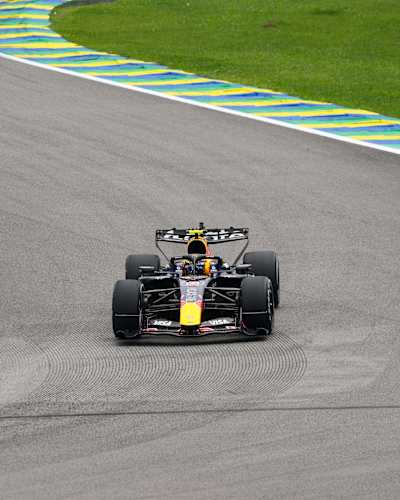


Small but perfectly formed, Interlagos is one of F1’s true classics, promising action, incidents, drama and, usually, a whole load of rain. It’s also been the scene of some of our greatest races. So, what can we expect this year?
01
Just like watching Brazil
This year’s Americas triple-header comes to a close this weekend at one of F1’s great old-school tracks – Interlagos. For a circuit that doesn’t seem all that special on the surface – only one of its 15 corners, the Senna S, stands out as a signature turn – it somehow flows into a properly challenging lap.
Maybe it’s the elevation changes, the tricky off-camber turns and the viciously technical, but never boring, middle sector that bring about no end of driver errors. Maybe it’s the unpredictable weather that frequently throws a rain-soaked cat among the racing pigeons. Or maybe it’s simply the sum of the parts: a little bit of motorsport alchemy in which seemingly dull old materials are cooked up into pure Grand Prix gold.
Whatever strange magic it possesses, it seems to bring out the wizardry in Max. The four-time champion is simply majestic at Interlagos – especially in the stormy conditions the circuit so often serves up. He has three wins at the São Paulo track, in 2019, 2023 and 2024, but that’s only half the story. On his first outing in Brazil with the team in 2016, he went from a wet-weather spin and 14th place to P3 at the flag. In 2024, Max delivered one of the truly great wet-weather wins, powering through from 17th on the grid to the top step. And last year, he did it again, powering from the pit lane to the podium.
Isack has had just a single outing at Interlagos, last year, but he put his Racing Bulls car into P5 on the grid and finished eighth after a tougher race. At the wheel of the RB22, it could be an even more exciting weekend for him this year.
02
Through the years in Brazil

Sebastian Vettel clinches the World Championship in Brazil in 2012
© Getty

Sebastian Vettel wins his third World Championship
© Getty

A Team photo in Brazil in 2012
© Getty

Mark Webber takes second in Brazil in 2013 for his final ever Grand Prix
© Getty
03
Memorable moments
04
What makes Interlagos unique?
A bit like a bunch of hoary old rockers being upstaged by the next-big-thing indie kids, no circuit would want to follow the incredible atmosphere of the Foro Sol section of Mexico’s Autódromo Hermanos Rodríguez – unless it’s Interlagos.
The Brazilian track is one of the very few that can rival Mexico City for the intensity of its atmosphere. And while the noise is similar, the groove is very different, defined by the thunderous samba beats coming from the grandstands on race day. The crowd is also startlingly close to the track along the pit straight, so from the moment the first car takes to the circuit on Friday, the vibe is palpable. It’s an infectiously thrilling place to be.
05
Circuit characteristics
At just 4.309km, the Autódromo José Carlos Pace is the fourth-shortest track on the calendar, behind only Monaco, Zandvoort and Mexico’s Autódromo Hermanos Rodríguez. Despite its brevity, the flowing, undulating lap packs in plenty of excitement.
The lap begins with a short, almost 200m run to the Senna S. The off-camber Turn 1 left-hander plunges downhill into Turn 2 before sweeping left through Turn 3, Curva do Sol.
Drivers then accelerate onto the Reta Oposta straight, which leads to the sweeping downhill Descida do Lago left-hander. After Turns 5 and 6 (Ferradura), the track climbs into a twisting, technical sequence through Turns 7 to 10, culminating in Bico do Pato. The final section takes in Turns 11 and 12 (Junção), before the flat-out 1.2km run to the start-finish line.
All of that makes Interlagos a bit of a set-up puzzle, with contrasting demands across its three sectors. Sectors 1 and 3 favour lower downforce for their long, high-speed sections, while the twisty middle sector requires more wing. At 800m above sea level, the air isn’t quite as thin as in Mexico last weekend, but it still encourages teams to run higher downforce levels than they might otherwise choose. However, this must be balanced against the drag penalty on the 1.2km run from Turn 12 to Turn 1. Finding the right aerodynamic compromise is crucial to a competitive weekend.
06
Key overtaking zones
There are two main overtaking points at Interlagos – Turns 1 and 4. The first, at the opening of the famous Senna S, is a 105km/h left-hander that dips downhill from the pit straight. The preferred attack is down the inside, launching off a slipstream picked up at Turn 12 and carried up the hill and along the long arc to the pit straight (the OM zone is here this year). Going around the outside is also possible, and more spectacular, but watch out for plenty of lock-ups under later braking.
The other major opportunity comes just a couple of corners later, at Turn 4, Descida do Lago, at the end of the long Reta Oposta straight. Another downhill left-hander, this one is taken at around 150km/h in third gear and, with SM here, it should be possible to pass either on the straight or under braking into the corner.
07
Strategy watch
The tyre selection for Interlagos has been a yo-yo affair over the past few years, and this year’s choices hark back to the 2024 allocation of C3 as the Hard, C4 as the Medium and C5 as the Soft.
During the 2024 race, heavy rain meant the dry-weather tyres were not required at all, but when they were used in Friday practice, teams reported high levels of wear, as well as graining, especially on the rear axle. The circuit had been completely resurfaced, leaving a very smooth surface that was less abrasive than in previous years, although there were still plenty of bumps around the track.
Moving on to last year, when the tyres were a step harder and the race was dry, the Hard saw little use, with teams favouring two-stop strategies based around the Medium and Soft compounds.
Will the move back to a C3-C5 allocation bring the Hard tyre into play this year? In all honesty, Friday’s work will be all about seeing how robust the C4 and C5 are before planning from there. But it’s certainly Pirelli’s intention to have all three compounds in use during the race. Max used all three last year across a three-stop strategy that included an unplanned stop due to a puncture, which sent him on a remarkable journey from the pit lane to the podium. This time, though, we’ll be hoping for a more conventional strategy, starting further up the grid.
08
What else should fans look out for?
Weather – Rain is what makes Interlagos simultaneously great and immensely difficult, confusing and frustrating. And it’s never far away. In 2019, Friday practice was disrupted by downpours. In 2010 and 2022, qualifying was affected by thunderstorms, while in 2024, deluges led to the session being postponed until Sunday morning.
Race days have also turned into soggy thrillers thanks to the rain. Chaos in the 2003 race led to just 10 cars finishing, with the trophies being handed out two weeks later as no one could decide who’d actually won (it was Giancarlo Fischella , even though his Jordan was on fire in the pit lane). In 2016, Max gave us the first indication of his wet-weather prowess with a brilliant drive to fourth in torrential rain. And, of course, there was 2024, when Max produced a wet-weather drive for the ages, climbing from 17th on the grid to the top step of the podium.
Will it rain this weekend? See that bear over there in the woods, he’s taking…
Yes, according to the latest forecasts, there’s a high probability of scattered storms on Thursday, Friday and Saturday. Sunday might bring rain in the morning, but conditions are expected to clear for the race.
Strategists, pencils at the ready! This one could get complicated.
09
Recent race results
Autódromo Carlos Pace
Driver
Grid
Race
2021
Max Verstappen
2
2
Sergio Pérez
4
4
2022
Max Verstappen
3
6
Sergio Pérez
4
7
2023
Max Verstappen
1
1
Sergio Pérez
9
4
2024
Max Verstappen
17
1
Sergio Pérez
12
11
2025
Max Verstappen
19
3
Yuki Tsunoda
17
17