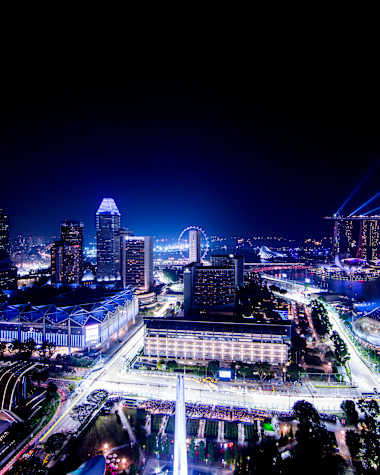


Out of the frying pan… From hot, sticky and glorious Sepang we head down the road to a potentially
even more superheated challenge – Singapore’s Marina Bay Street Circuit. So, what has F1’s OG night got in store for us this year?
01
Light it up
Hang on, wait a minute. We’ve only just surfaced after celebrating Max’s magnificent win in Sepang – and the first for Red Bull Ford Powertrains – for a couple of days and now you say we have to reset for another race?
We certainly do. As the season races towards its conclusion, the races are coming thick and fast and, like last weekend’s Bahrain Grand Prix in Malaysia, the next one coming down the track is another gruelling voyage into extreme heat and humidity. Yep, it’s time for F1’s original night race, the Singapore Grand Prix.
But while both races push the needle up the space marked ‘broiling’, that’ where the similarities end, because while Sepang has always been a happy hunting ground for the team, Singapore is… different.
On the plus side, we have four wins at the Marina Bay Street Circuit. We’ve also had more podiums in Singapore than any other team, with 16 top three finishes. But even though we’ve had plenty of success here, it’s a circuit that has often left us more puzzled than pleased and it remains the only track on the calendar at which Max has failed to win.
So how might the 17th edition of F1’s first night race play out? Let’s take a look.

Daniel Ricciardo takes second at the 2017 Singapore Grand Prix
© Getty

Pit stop practice back in 2017
© Getty

Daniel Ricciardo on track in Singapore in 2018
© Getty

Big smiles in the garage in 2018
© Getty
02
Memorable moments
03
What makes the Marina Bay Street Circuit unique?
Marina Bay’s superpower is the climate. It’s hard to separate the race from the amazing cityscape and the buzzing vibe of one of the world’s most exciting cities, but if you did manage to pull all that away, you’d be left with a street layout with close barriers, a winding layout, and a couple of overtaking spots. So far, so regular. It isn’t the quickest street circuit, that would be Jeddah. It doesn’t have the biggest light show, that would be Vegas. But because of the conditions, it is undoubtedly the toughest.
Oppressive 35˚C heat, 80% humidity, 19 punishing corners that offer little time to rest, minimal breeze, the ever-present threat of tropical thunderstorms and the glare of thousands upon thousands of lights. Marina Bay is street racing at the edge of endurance. For drivers, that’s a daunting but enticing challenge. And for fans, it’s a spectacle unlike any other.
04
Circuit characteristics
How does long, complicated, hot, humid, and stressful sound? That’s Marina Bay in a nutshell. Even though the circuit was shortened from 5.063 km to 4.927 km in 2023, resulting in the corner count dropping from 23 to 19, lap times falling by 10 seconds and the lap count being reduced by one, this is still a punishing layout that demands total focus in quite extreme conditions.
The stop-start nature of the track, high heat and humidity make Marina Bay perhaps the most physically demanding race of the season and it’s not uncommon to see drivers needing to sit and recover after spending almost two hours in cockpits where temperatures can soar to well above 50 degrees Celsius. In the past, the race frequently hit the two-hour time limit, making it even more demanding, and while that doesn’t happen following the track changes, safety cars can still extend the time significantly. So intense are the conditions that drivers can lose several kilos of weight during the race through fluid loss.
It's not just the heat that makes the race tough. These are city streets and they have a plethora of jarring bumps that leave drivers pretty bruised and battered by the time they reach the chequered flag. A number of sections were resurfaced last year and that made life a bit more bearable, but as Max said about Sepang last week, at Marina Bay drivers need to get “comfortable with the uncomfortable”.
It’s not just the drivers being pushed to the limit in Singapore. Cars take a beating too. Effective cooling, particularly of brakes and PUs, is hard to achieve here. It’s not just the ambient temperature either. The closed-in nature of the track and the tall buildings mean there’s hardly any breeze, so temperatures just climb and climb.
05
Key overtaking zones
As with most street circuits, overtaking opportunities are in short supply in Singapore. However, track modifications in 2023 reduced the corner count from 23 to 19, cutting out the slightly pointless fiddly section from the old Turns 16-19 to create a long straight ending in a hard-braking 90-degree right-hander. Get a good exit out of Turn 14 (an old passing point, where overtaking is still possible), utilise the last of five Straight Mode zones well and a move is possible.
The other major opportunity is Turn 7. Located at the end of the long Raffles Boulevard straight, and at the end of the second SM zone, cars brake from around 190 km/h to 115 km/h for this left-hander. It’s bumpy here and therefore it’s easy to make a mistake under pressure and get passed.
06
Strategy watch
The first thing to say about strategy is that we’re on a street track, and though the track modifications have helped, overtaking is still tricky. That means grid position is hugely important. Get yourself as high up the grid as possible on Saturday and you’ll have half your Sunday workload done. Three of the last five Singapore Grands Prix have been won from pole and, in all, 11 of the 16 races here have been won from top spot at the start. It is possible to progress to the podium from lower down, with 18 podiums being scored from lower than third on the grid. However, only six of those podiums have been scored from below P5 at the start.
Track evolution is incredibly high in Singapore, given that it is a street circuit. The surface can ramp up by as much as three seconds between FP1 on Friday and Qualifying on Saturday evening, so choosing the right moment for that all-or-nothing flyer in quali is really important.
One curious outcome of the 2023 track changes is that the shorter lap puts less stress through the tyres and whereas Soft tyres would often drop off at the end of flying laps in qualifying, the circuit is now a bit kinder to the rubber.
For Singapore, Pirelli have chosen the softest trio in the range, with the C3 as Hard, C4 as Medium and C5 as Soft. It’s the same combination as last year and in that race Max started on the Soft before switching to the Hards on lap 19. That choice, however, is slightly misleading, as rain in the build-up to the race cleaned the track and the thought was that Softs at the start might provide more grip and a chance to pass George Russell at the start. It didn’t happen for Max, but he managed the Softs well in the opening stint to hold P2 and then race to the flag on C3s.
Thermal stress is the main cause of tyre performance degradation in Singapore, so a Medium/Hard strategy has generally been the way to go. However, the Soft has been a racier tyre this season, so it might yet be a factor, for the start or if there’s a late Safety Car.
For the Sprint, it should be the Medium, but if you’re out of position on the grid you might fancy the C5 to gain ground and then go defensive, but chances are you won’t do that and 23 sensible laps on the C4 looks the best option.
07
What else should fans look out for?
Have we mentioned it’s a Sprint weekend? It’s the first time Singapore has hosted one of these, so competitive running starts early. The weekend’s only practice session and Sprint Qualifying are held on Friday, the Sprint and Qualifying on Saturday, and the Grand Prix, over 62 laps, on Sunday. On paper, a Sprint on streets where overtaking is pretty difficult doesn’t sound like a recipe for thrills. However, the prospect of two quali sessions on the streets of Marina Bay is pretty exciting.
08
Recent race results
Marina Bay Street Circuit
Driver
Grid
Race
2019
Max Verstappen
4
3
Alex Albon
6
6
2022
Max Verstappen
8
7
Sergio Pérez
2
1
2023
Max Verstappen
11
5
Sergio Pérez
13
8
2024
Max Verstappen
2
2
Sergio Pérez
13
10
2025
Max Verstappen
2
2
Yuki Tsunoda
13
12