F1
Timing, tyres, and a ticking clock: How F1 qualifying really works
F1 qualifying sounds simple enough – one lap against versus the stopwatch and 21 rivals to chase pole position. How to achieve it? That’s a more complex equation …
Racing is one thing. But if you really want to know how fast an F1 driver is? It’s in qualifying.
One lap, no regard for tyre preservation, fuel management, long-term strategic thinking or playing it safe. One driver, against the clock.
While the duration of that test of tests can vary – a lap of the Red Bull Ring in Austria will take roughly 66 seconds, while a single lap of Spa-Francorchamps in Belgium will last roughly 104 – the same principles apply. Take as many risks as you dare, rachet up the aggression and precision to tiptoe on the tightrope separating hero and zero, and optimise everything.
Qualifying is F1’s biggest stress test, an examination that separates the great from the merely very good. But how does it work?
Join us on a flat-out run through how qualifying unfolds, what decisions are being made at light speed in real time, and all of the various parameters that, when they come together, put you in the ideal position to start the race, when the big prizes – points, trophies and bragging rights – are handed out.
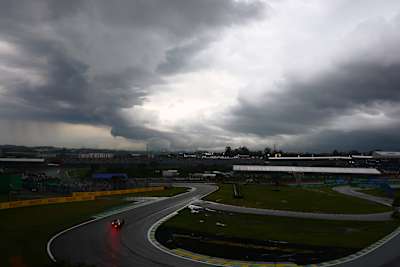
Isack during qualifying at Interlagos
© Getty
How does the qualifying format work?
With 22 drivers on a modern-day F1 grid, the starting positions are determined in three separate Saturday qualifying sessions, Q1 (which lasts for 18 minutes), Q2 (15) and Q3 (13). This is where you need to temporarily divert your eyes to the bottom of the timesheets, not the top – at least for Q1 and Q2.
In Q1, all 22 drivers set a lap time; the slowest six drivers after that initial 18-minute period are eliminated and make up places 17-22 on the grid for the race. For Q2, the slowest six of the remaining 16 drivers are eliminated to make up places 11-16. Q3, the final shootout for pole position, determines starting spots 1-10.
With no carryover of lap times – and therefore positions – in Q1 and Q2, there’s no point being fastest in either session; the task is merely to avoid being one of the six slowest.
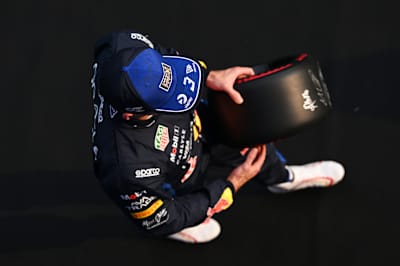
Max qualifies in pole position at the Bahrain Grand Prix in Malaysia
© Getty
How a driver approaches each session is largely to do with how strong their car is. If you’re a backmarker team, escaping Q3 and not being one of those six slowest is the goal, and you’ll throw everything you have into a Q1 lap. If you’re a potential challenger for pole, it’s all about doing enough to get through without overstressing yourself or your machinery, gradually increasing your risk/reward ratio for when it really matters.
Across a 24-round season, some qualifying sessions have more importance than others, based on the level of difficulty in overtaking at a particular track.
At Monaco – where qualifying on pole has led to victory nearly half the time since 1950 – a good qualifying showing almost guarantees a strong race result given passing is so tough. The Circuit de Barcelona-Catalunya in Spain, though – which couldn’t be more different – has a historically higher pole-to-win ratio; since 1991, there’s only been 11 races not won from pole, making Saturday as crucial as Sunday.
The tyre equation
At each Grand Prix that doesn’t feature a Sprint race, each driver gets an allocation of 13 sets of dry-weather slick tyres, which come in a configuration of soft, medium and hard compounds. A driver also gets five sets of intermediate tyres for conditions that are neither fully dry nor wet, and two sets of wets.
Remember when we said that Q1 and Q2 are all about not being one of the six slowest rather than the fastest? That plays into tyre usage, too; if you’re in a top team and think you can advance to the next phase of qualifying by perhaps using a theoretically slower tyre while saving more fresh sets of a faster tyre for Sunday’s race, then it’s worth rolling the dice with an eye to the Grand Prix proper.
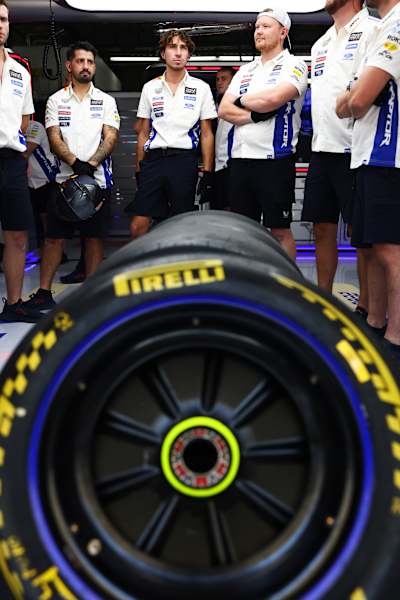
The garage looks on during qualifying at the United States Grand Prix 2026
© Getty
Is the medium a better tyre for the race? Do you want two sets of brand-new softs for Sunday? They’re decisions that vary from driver to driver, team to team, track to track.
Qualifying impacts on race strategy, too; each driver must use two of the three different compounds in a dry-weather Grand Prix, which means at least one pit stop.
Being able to put fresh tyres aside for the race – if you can navigate qualifying without compromising your grid position – can make or break a result 24 hours later.
The ticking clock
There’s nothing more exhilarating for a driver than the timer ticking down to zero in each of the three qualifying segments; a Q3 session at Monaco, where drivers lay it all on the line as the clock counts down, is as white-knuckle as F1 gets as the gap between success and failure becomes almost imperceptible.
Broadly, in a dry qualifying session, the circuit will get faster – you’ll hear the term ‘ramped up’ – the longer it goes as more rubber is laid down on the tarmac, which equals more grip to be exploited and lap time gained. The final ‘push’ laps of a session will theoretically be the time to try for your best lap, but there’s caveats.
With everyone trying to do the same thing at the end of a session, the probability of incident and accident rises sharply. If a driver runs off or crashes ahead of you, a yellow flag – which compels you to slow down, per regulation – can ruin your best efforts through no fault of your own.
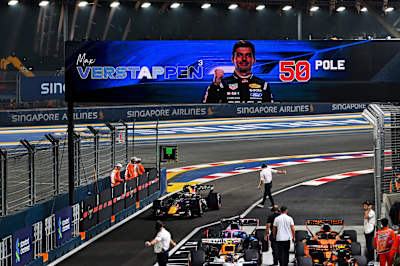
Max reaches his 50th career pole position in Singapore in 2026
© Getty
Broadly, teams will approach each segment of qualifying in two parts; go out early in the session and push for a lap time while leaving some margin, getting a ‘banker lap’ in so you have a time on the board, and then going again right at the death to push the envelope those couple of extra percentage points.
Make a mistake, get compromised by a yellow flag or come up on a rival driver at an inopportune time or place on track? Plenty of pole positions have been earned by that banker lap not being a driver’s best effort, but being good enough.
Strategies and penalties
The configuration of a track can also play a part in how to extract the optimum lap time at certain circuits, too.
At tracks with sections of full throttle/no braking – Baku in Azerbaijan (2.2km), Spa-Francorchamps in Belgium (2km), the Autodromo Hermanos Rodriguez in Mexico City (1.2km) and Monza in Italy (1.1km) come to mind – a well-timed slipstream can slingshot you down a straight to shave lap time in qualifying; teams will often deploy one of their drivers to ‘tow’ their teammate down certain sections of track and then move out of the way to build extra speed and save slivers of a second that could be crucial for grid position.
Penalties, on multiple fronts, also play a part.
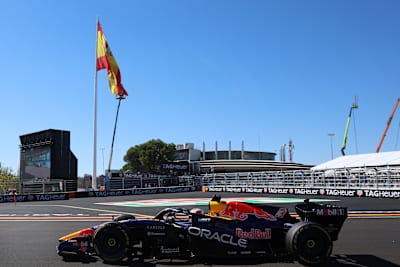
Max qualifying ahead of the Spanish Grand Prix 2026
© Getty
If a driver knows they have to take a penalty for the race because of an engine or gearbox change, their qualifying position could be subject to a grid drop of anywhere from five to 20 places, meaning there’s less incentive to chew through tyres and more emphasis placed on data-gathering for the following day.
During qualifying, drivers can earn the ire of the stewards for impeding a rival on a flying or ‘push’ lap, ignoring or failing to slow for marshals’ flags and breaches of protocol in pit lane, to name but a few no-nos. Penalties can range from a driver having a lap time annulled for minor offences to grid position drops to exclusions in more severe circumstances.
In short, there’s a long list of considerations for the most pressure-packed 60-100 seconds, save for the start of a race, of any F1 race weekend in qualifying.
Strap yourself in, and make sure those belts are done up tight …